|
|
|
|
|
|
|
|
Welcome to the Salisian | Lee LLP Newsletter
|
|
|
Welcome to the Spring 2024 issue of the Salisian Lee LLP Newsletter! As usual, we provide updates on important changes here at the firm, as well as new laws and new legal issues. We hope you enjoy this edition and if you have any questions or concerns, please email info@salisianlee.com. Happy Spring!
|
|

|
|
|
|
|
|
|
|
|
Firm News
- In January 2024, Salisian Lee LLP Co-Founding Partner Richard Lee transitioned to an Of Counsel role with the firm. He continues to operate under the firm umbrella on all of his cases. We are all very grateful for Richard's contributions - from the firm's inception to the present - and are thrilled he has chosen to remain on as a valued member of our team.
- We welcomed new associate Brian Zhang and legal secretary Alberto Araujo, who both joined us recently. We look forward to getting them both integrated in our extremely busy litigation practice as soon as possible and invite all of our clients and staff to extend a warm welcome.
- As part of our ongoing commitment to growing our firm culture with our social events, so far this year we have flexed our paintbrushes at a Paint N Sip, watched the Dodgers battle the Nationals, and celebrated birthdays and anniversaries.
|
|
In the Spotlight: Jennifer Goldstein, Associate
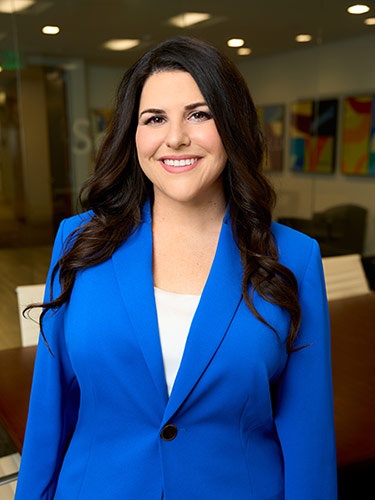 Spring is a time for renewal and growth, a concept that has even extended to our offices. A few months ago, we were fortunate to welcome Jennifer Goldstein, a valuable new addition to our litigation practice. Since many of our clients will now have the pleasure of working with Ms. Goldstein, we thought an interview to gain some insights on who she is – both professionally and personally – might be in order. Spring is a time for renewal and growth, a concept that has even extended to our offices. A few months ago, we were fortunate to welcome Jennifer Goldstein, a valuable new addition to our litigation practice. Since many of our clients will now have the pleasure of working with Ms. Goldstein, we thought an interview to gain some insights on who she is – both professionally and personally – might be in order.
Welcome to the firm Jennifer. Let's start at the beginning - what made you want to be an attorney?
I have always loved history and politics and, from an early age, I felt compelled to use my talents to better the world. After a steady intake of Erin Brockovich and participating in competitive debate, law went from an idea to a foregone conclusion. From the beginning and to this day, I practice law to help people work through their toughest challenges.
And what drew you to Salisian Lee LLP at this stage in your career?
Salisian Lee offered me the opportunity to take my practice to the next level. I am interested in strategically litigating my cases in line with the clients' objectives, including from a business perspective. The attorneys at Salisian Lee share this attitude and foster a strong line of communication between the associates and the clients that benefits the cases. The firm also supports associates who, like me, have an interest in developing their own practice areas and client relationships. I also enjoy the firm's culture. The attorneys and staff are extremely talented and immersed in the cases, but also approachable, enthusiastic, and fun. The Salisian Lee energy is unique for a law firm (in the best way).
What do you love most about the practice of law? What do you find the most challenging?
I love that law affords me the ability to help people resolve their most difficult problems. Collaborating with our clients on winning strategies is the best part of practice. Explaining the expense and inefficiency of the legal system when a client requires immediate resolution is the most challenging part of practice.
What advice have you received in your career that made the most meaningful impact?
Say as much as necessary and as little as possible.
Who are your role models?
Ruth Bader Ginsberg, Lyndon B. Johnson, Nancy Pelosi, Franklin Roosevelt, Scarlett O'Hara, and, of course, my mom.
What do you like to do in your free time?
I enjoy Saturdays at the beach, hot yoga, seeking out the best omakases, and traveling the world.
|
|
In Greater Depth
|
|
|
|
|
|
|
|
|

|
|
The NAR Settlement Will Create Sweeping Changes, but Commissions May Stay the Same
By Marius Mateescu, Associate
|
|
|

|
|
The multiple billion-dollar cases filed across the country after the Missouri federal jury in Burnett v. National Association of Realtors issued a $1.8 billion verdict against the National Association of Realtors ("NAR") and its members for violating antitrust laws has resulted in a proposed settlement between the NAR, various home buyers, and NAR-affiliated brokerages, in which the NAR has agreed to pay $418,000,000 over three years.
The central issue in these matters is whether the rules promulgated by the NAR and its members' agreement to abide by them unfairly restrained trade in the residential real estate industry. Under scrutiny is a requirement that all NAR members agree that real property purchase contracts contain a unilateral offer to a NAR-affiliated buyer's broker for a commission amounting to a percentage of the property's sales price, in exchange for access to multiple listing services. These services advertise various properties in geographic areas throughout the United States to NAR members representing buyers and sellers. Plaintiffs allege NAR's practice of mandating use of the databases to make commission offers to buyer's brokers was an unlawful conspiracy to restrain trade because it artificially raised home prices.
The NAR steadfastly maintains that its practices are lawful because the net effect was to encourage, not stifle, competition, resulting in an efficient market. Specifically, the NAR contends the practice at issue benefits consumers, homeowners and homebuyers, and the overall real estate market because it allows buyers to hire experienced and qualified professionals, who guide consumers quickly to homes listed in accordance with accepted industry standards designed to protect them and ensure professional integrity.
Rather than litigate further, the NAR entered into a proposed settlement on March 15, 2024, preliminarily approved on April 23, 2024. The settlement is between the various classes in the nationwide matters. It captures almost all parties transacting in homes sold since October 31, 2019 in certain states, unless they opt out, as well as NAR and its member brokerages meeting certain conditions.
In exchange for certain "practice changes" and $418,000,000 payable in installments, the various classes released NAR and its members from billions in antitrust liability. The "practice changes" are rather sweeping and rewrite current industry rules. For example, they include the following:
- Elimination of the unilateral offer of compensation to buyer representatives;
- Elimination of requirements conditioning participation in a NAR-affiliated multiple listing service on offering or accepting unilateral offers of compensation to buyer representatives;
- Agreement to not create or support a “non-MLS mechanism” for listing brokers to make unilateral offers of compensation to buyer representatives, subject to certain conditions.
These changes are designed to decouple the buyer's commission payment from the sale of a home listed on a NAR-affiliated multiple listing service. In turn, the hope is that the market will dictate the commission rate, rather than through contracts entered into by the NAR and its members. This change is monumental, as the NAR allegedly set commissions through its market power in the past — although the NAR contends the commissions were always negotiable, the classes contend that in reality, they were not given the practical operation of the multiple listing services.
Interestingly, however, the practice changes do not "prevent offers of compensation to buyer brokers or other buyer representatives off of the multiple listing service." Given this language, it appears commissions may still be set between agents through bilateral contracts, entered into via some avenue other than the multiple listing services. Thus, the settlement agreement seemingly allows entrepreneurs to create a path by which a particular region's agents can collectively agree to a certain commission rate by some method other than blanket offers made on the multiple listing service.
For example, one can envision an electronic mobile application that creates a contract between all agents within the Los Angeles region, facilitating the setting of certain commissions via bilateral contracts on a region-wide basis. The application may be created and made available for download on Android and Apple devices within the Los Angeles region. Agents operating in Los Angeles County could then all could privately agree to 5-6% commissions, split evenly between the brokers – that is, the very same commission scheme that previously existed for residential home sales.
Because this type of contractual commission arrangement seems to not implicate the multiple listing services, it appears permissible under the settlement agreement. Although such an application could arguably be a prohibited "non-MLS mechanism for listing brokers or sellers to make offers of compensation to buyer brokers or other buyer representatives," if the application facilitates a bilateral contract, as opposed to a unilateral offer of compensation, it may potentially circumvent the prohibition.
The issue then, apart from possible antitrust liability, would be convincing consumers to agree to these commission splits. Before, the multiple listing service's operation effectively forced consumers to agree to the commission set out in the multiple listing services due to all brokerages using the services as a general practice. Effectively, the homes appearing on the services, which brokers introduced to buyers, were all allegedly burdened with the unilateral offer, so buyers had no room to negotiate.
But now consumers will have bargaining power to refuse the commission split because the listing services will no longer force them to agree, and they will not be bound by the private agreement between agents. Agents will have to use their negotiation skills to explain to consumers that the commissions are now set by private agreement amongst a region's agents, and that such commission is the standard rate for competent representation in the region. Perhaps the application can be styled as creating an association of agents who are devoted to the highest level of professional service.
In any event, although the scope of the changes in the proposed settlement agreement are unclear, one thing is clear: change is coming.
|
|

|
|
Sports Betting: The New Frontier of Class Action?
By Jared T. Densen, Associate
|
|
|

|
|
Many people, particularly in the United States, love to gamble. In 2023, Americans gambled at a record pace and gaming institutions recorded a record $66.5 Billion in profits.1 Sports betting, in particular, accounted for $10.92 Billion in revenue, up 44.5% from the previous year.2 Americans legally gambled $119.84 Billion on sports in 2023.3 At least 5 new states legalized sports betting and allowed it to become operational in 2023 – Kentucky, Maine, Massachusetts, Nebraska, and Ohio, with sports betting in New York previously becoming operational in 2022. All of this does not even factor in the billions of dollars wagered, won and lost, on illegal sports books in other markets, such as California.
With the rise in legalized sports gambling, new players are entering the market to grab as much of a share of this massive pool of dollars. In particular, ESPN, the self-proclaimed Worldwide Leader in Sports, has partnered with Penn Entertainment to create ESPN BET, a dedicated sportsbook for American audiences.4 Penn reached a ten-year, $2 billion deal with ESPN to create ESPN BET.
Sportsbooks aren't new, as sports gambling has been prevalent since the dawn of sports, but when the leader in sports coverage joins the betting ranks, is there cause for conflict concerns?
ESPN has dedicated analysts, commentators, and reporters who cover sports around the globe. For decades, these pundits and reporters have only briefly touched on the gambling odds of games and certain bets. However, over the last handful of years, it seems that the topic of gambling has expanded and taken center stage in these conversations on television and in online media.
Sports gambling is here in a big way and is here to stay; it arguably adds extra fun or "juice" to games that fans otherwise wouldn't particularly care about. The possible conflict arises when the very pundits that cover a game are employed by the same entity that now also has a financial stake in the game's outcome.
The analysts, commentators, and reporters report on a particular game, injuries of players, pros and cons of one team or one player versus the other, etc. What if the line for an NFL game is -2.5 (meaning one team is favored to win by more than 2.5 points), and the reporters and pundits state that one team's quarterback is hurt, ill, or not having a strong season, and then the line shifts? Before ESPN BET, this wouldn't be an issue, because the sportsbooks were run by independent casinos or third-party operators. Now, however, ESPN is the book maker, and controls the betting odds, along with the narrative of the game, player(s), team(s), etc. There is clearly an ethical - and possibly legal - conflict of interest that could now arise.
So far, the most notable example of this conflict of interest occurred outside the realm of an actual game, but during a major sporting event nonetheless: the 2022 NBA Draft. ESPN's leading NBA insider Adrian Wojnarowski significantly altered gambling odds for the draft when he sent out one tweet, reporting that the first, second and third picks were, according to a source, likely to be "Jabari Smith Jr. to Orlando, Chet Holmgren to Oklahoma City, and Paolo Banchero to Houston." Up to that point, Paolo Banchero was the favorite to be selected first overall, but then one single tweet by Wojnarowski dramatically shifted the odds, with sports gamblers racing to change their bets, and sportsbooks adjusting their betting lines. Then, just before the first pick was announced, Wojnaroski sent another tweet: that Banchero was now the favorite to be the selection at number one. At this point, it was no longer feasible for odds to change, for bettors to change bets or place new bets. Banchero was ultimately selected first overall in the 2022 NBA Draft.
Now, the result was not ultimately impacted in this example, but it is an illustration of how a dilemma for ESPN and ESPN BET could potentially occur. ESPN's lead NFL insider Adam Schefter has the power to go on an ESPN show or send a tweet, discussing the absence of a critical player at practice, a potential trade between teams for a critical player, the progress of a young player coming into the NFL, a player's mental capacity to be great (or not), or anything under the sun. As seen with Wojnarowski's tweets, this in turn has a high likelihood of altering betting odds on a number of different bets.
In another scenario, assume there is a nationally televised NBA matchup between LeBron James's Los Angeles Lakers, and Kevin Durant's Phoenix Suns. There is already much intrigue for such a matchup, and ESPN undoubtedly wants eyes on that game. ESPN's lead NBA reporter Stephen A. Smith could hype up the game between two legends and juggernaut teams yet know there is a possibility that James and/or Durant are not going to play for a variety of reasons. Now, it is a journalist's ethical duty to report this, but in order to keep viewers tuned to the game, and bets flowing through ESPN BET, Smith may hold this information back until the very last moment before tip-off when it is too late for any bets to be changed, and viewers already tuned in ready to watch. Since ESPN BET makes its money off a portion of each individual bet, it's in their interests to have as many eyes on a game – and bets on the line – as possible. If providing misleading, inaccurate or specifically timed details via their editorial arm accelerates betting – that's a problem.
Through these examples, it becomes clear how reporters, insiders, and journalists have the capacity to manipulate betting markets, and how specifically, ESPN can profit off these market shifts. ESPN has always had the power to effectively control the betting behavior of sports gamblers via their media coverage, but now they also have the ability to directly profit from of that control. Should their lawyers be worried?
First, there is the possibility of a class action lawsuit against ESPN, ESPN BET, and their employees. Gamblers who watch and listen to ESPN – one of the most watched sports broadcasters in the U.S. – for their sports content and information, could easily have a cause of action for being misled, misinformed, or deliberately lied to in order for ESPN and ESPN BET to profit.
Second, the government could decide to regulate in this area, which has never seen this sort of vertical integration of sports and a betting platform. Congress could decide they need to protect gamblers or that all sports gambling must be controlled by third party operators, such as DraftKings or MGM.
Moreover, the impact on the youth is also a consideration. Sports are for everyone, not just adults over the age of 18 – the legal age to gamble. With the influx of gambling content on ESPN, the government could also regulate how the shows operate in order to protect younger, more vulnerable viewers. Americans under 18 are already finding ways around road blocks, and ESPN is not so subtly encouraging gambling whether those viewers wanted gambling information or simply wanted to watch their favorite sports.
Once this "experiment" has been conducted legally for a few years, we could see major lawsuits, major regulations, and/or major changes to the whole infrastructure if ESPN is not careful. Maybe their legal teams should get ready now.
1 https://apnews.com/article/casinos-best-year-revenue-gambling-betting-slots-6cefeecd6631fb6d102bac191179e3a0
2 Id.
3 Id.
4 https://www.espn.com/espn/story/_/id/38158198/penn-entertainment-rebrand-sportsbook-espn-bet
|
|

|
|
Pending Supreme Court Ruling on City's Response To Homelessness Crisis: An Overview
By Danya Elbendary, Associate
|
|
|

|
|
City of Grants Pass v. Johnson, U.S. No. 23-175 (2024)
On April 22, 2024, the Supreme Court heard oral arguments in a case that questions whether a city's enforcement of non-camping ordinances against unhoused individuals violates the Eighth Amendment's Cruel and Unusual Punishment clause.
Specifically, the ordinances at issue – sections 5.61.010, 5.61.020, and 5.61.030 of the City of Grants Pass Municipal Code – prohibit sleeping on public sidewalks, streets, alleys, or doorways at any time, state that "no person may occupy a campsite in or upon any sidewalk, street, alley, lane, public right of way, park, bench, or any other publicly-owned property or under any bridge or viaduct," and define "campsite" as "any place where bedding, sleeping bag, or other material used for bedding purposes." However, the homeless population in Grants Pass exceeds the number of available beds provided by private homeless shelters in the city, which thereby forces some unhoused individuals to sleep on the street.
Respondents are two homeless residents of Grants Pass who filed suit to enjoin the city from enforcing these ordinances, which they argue punish them for sleeping outside when they have no alternatives, and therefore criminalize the status of homelessness in violation of the Eighth Amendment's Cruel and Unusual Punishments clause.
The district court ultimately agreed with Respondents' position, and on appeal, the Ninth Circuit held that the district court correctly concluded that the city's anti-camping ordinances violated the Eight Amendment pursuant to Martin v. Boise, which held that the Cruel and Unusual Punishment clause prohibits the criminalization of "sitting, sleeping, or lying outside on public property for homeless individuals who cannot obtain shelter." 902 F.3d 1031 (9th Cir. 2018).
Notably, this claim is also controlled by a 1962 case, Robinson v. California, which held that criminalizing someone for living with a status, such as addiction, was forbidden by the Cruel and Unusual Punishment clause. See 360 U.S. 660. Accordingly, oral argument focused mainly on the question of whether the ordinances criminalized the conduct of camping, which is seemingly not prohibited by Robinson, or the status of being homeless, which would be prohibited under Robinson.
Petitioner argued that the Ninth Circuit "tied cities' hands by constitutionalizing the policy debate about how to address growing encampments;" that it misread Robinson to bar any punishment for involuntary conduct that's linked to a status, arguing that it instead held only that states cannot outlaw the status of drug addiction; and ultimately, that the Eighth Amendment's Cruel and Unusual Punishment clause governs what punishments are permitted, rather than what conduct can be prohibited, rendering it inapplicable to the instant case. In response to questioning from Justice Kagan regarding the fact that the conduct of sleeping is a biological necessity that requires homeless individuals without alternatives to sleep outside, Petitioner argued that a necessity defense would be available under these circumstances pursuant to Oregon law.
Alternatively, the federal government raised the issue of mootness, arguing that there is no live controversy presented by this case, as required by Article III for judicial review, in light of a recently passed Oregon statute requiring that any restrictions on sleeping or resting outside are reasonable with respect to homeless individuals. See OR. Rev. Stat section 195.530. The government argued that this statute prevents Grants Pass from enforcing the subject ordinances, as they do not meet the standard that it sets, and accordingly, the case should be dismissed as improvidently granted. Otherwise, the government argued that chaos would ensue if Martin were to remain on the books, as the punishments described here, which include low-level fines and short jail time for repeat offenders, are not of the type that are "cruel or unusual," and that ultimately the Eighth Amendment does not answer the policy questions raised by this case.
Finally, Respondents argued that pursuant to Robinson, status-based punishments like the ordinances at issue are categorically cruel and unusual, and that in practice, the ordinances subject unhoused individuals in Grants Pass to repeated fines and jail time for resting, while the non-homeless are permitted to rest in public freely. Further, in response to the arguments raised regarding the distinction between punishing status versus conduct, Respondents argued that adding a "universal human attribute to the definition of the offense," namely, sleeping, does not make the offense conduct based, as the ultimate effect of the ordinances is the same. Lastly, Respondents argued that because at the time Robinson was decided, the Court believed that addiction was a status that could change, as opposed to the modern view that it is a lifelong condition, the permanency of the condition does not matter under Robinson, such that the fluid status of homelessness is irrelevant.
It is not entirely clear whether the high Court will ultimately reach the merits of this case given the mootness arguments raised in light of a recently passed Oregon statute, which Justice Jackson appeared to raise as a potential limitation, as well as the potential necessity defense offered by Oregon law. Nonetheless, a substantive decision here would have far-reaching implications on the extent to which governments may go to regulate the rising homelessness crisis across the United States, making this a critical case to watch.
|
|
|
|
|
|
|
|
|
|
Legal Disclaimer: The information contained in this newsletter is provided for informational purposes only, and should not be construed as legal advice on any subject matter. No recipients of content from this newsletter, clients or otherwise, should act or refrain from acting on the basis of any content included in the site without seeking the appropriate legal or other professional advice on the particular facts and circumstances at issue from an attorney licensed in the state of California.
|
|
|
|
|
|
|
|
|
|
|
|
|
Copyright © 2024 Salisian Lee | LLP. All rights reserved.
|
|
|